

Girthy? Off his feed? Gone a bit sour under saddle? Gastric ulcers are one of the most common — and most overlooked — reasons a horse stops feeling like himself.
Equine gastric ulcers are far more widespread than most owners realize, and the good news is that thoughtful feeding and the right digestive support go a long way toward preventing them. Here's what causes ulcers, how to spot them, and the natural, research-backed ways to support a healthy stomach.
Just how common are equine gastric ulcers?
Very. Studies consistently find ulcers in a large share of performance and racehorses, and they're common in leisure horses too. The reason comes down to how a horse's stomach is built: it produces acid continuously, whether or not there's food in it — because in nature the horse is grazing almost around the clock. Modern management (stabling, meal feeding, hard work, travel) breaks that pattern and leaves the stomach exposed.
Signs your horse may have ulcers
Ulcers are a great impersonator. Watch for:
- Girthiness or objecting to being saddled/rugged
- Picky appetite, or eating hay but leaving hard feed
- Weight loss or difficulty holding condition
- A dull coat and general "poor doer" look
- Attitude changes — grumpiness, resistance, teeth grinding
- Mild, recurrent colic, especially after eating
- Drop in performance or reluctance to go forward
Any combination of these is worth a conversation with your vet.
Why ulcers happen
It's a simple equation: acid + an empty stomach + stress. Long gaps between meals let acid splash the unprotected upper stomach; grain-heavy diets and intense exercise make it worse; and stress from travel, competition or box rest turns up acid production. Remove those pressures and you remove most of the risk.
Management first — the diet foundation
Before any supplement, get the basics right — they matter more than anything in a bottle:
- Forage, forage, forage. Near-constant access to hay keeps a fibre "mat" and saliva buffering acid. Use a slow feeder so it lasts.
- Never work on an empty stomach. A small feed of hay (a handful of alfalfa is a natural buffer) before exercise protects the stomach lining.
- Cut the grain. Replace starchy hard feed with fibre and oil-based calories where you can.
- Maximise turnout and minimise stress — more grazing, more friends, less box rest.
- Small, frequent meals beat one or two big ones.
Natural ingredients that support the stomach
Several well-known botanicals and nutrients are used to soothe and support the stomach lining — most valuable for prevention and day-to-day maintenance:
- Aloe vera — soothing and widely used for gastric comfort
- Slippery elm & marshmallow root — mucilage-rich herbs that coat and calm
- Licorice root — traditionally used to support the stomach lining
- Lecithin & pectin — help reinforce the stomach's protective barrier
- Pre- and probiotics + enzymes — support a balanced, healthy gut from stomach to hindgut
A vet-designed digestive supplement
If you want the gut-support piece handled in one scoop, Digest Plus is a vet-designed, low-starch powder that supports the stomach, foregut and hindgut together — combining digestive enzymes with pre- and probiotics, and formulated to improve how well your horse absorbs nutrients from hay and feed. It's also FEI- and USEF-safe, so it's suitable for competition horses.
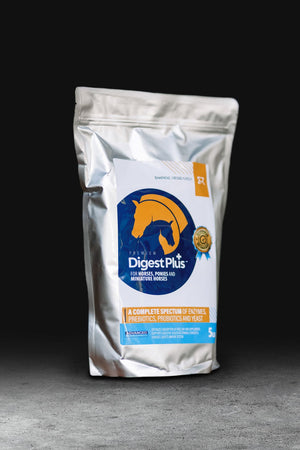
Vet-designed, low-starch digestive powder — enzymes plus pre- & probiotics for whole-gut support and better nutrient absorption. FEI- and USEF-safe.
For broader daily digestive and hindgut support, many owners pair it with our Daily Combo:
Prevention vs. treatment — an honest word
We'll always be straight with you: if your horse has moderate or severe ulcers, they need your vet and likely a course of omeprazole to heal — no supplement replaces that. Where natural digestive support genuinely shines is before and after: reducing the risk in the first place, supporting the gut during stressful periods, and helping maintain a healthy stomach once ulcers have healed. Used that way, it's one of the best investments you can make in your horse's comfort.
Frequently asked questions
Can gastric ulcers in horses heal on their own?
What should I feed a horse with ulcers?
Can I use a supplement alongside omeprazole?
How long before I see an improvement?
The bottom line
Gastric ulcers come from long gaps, grain and stress — and they respond to the opposite: constant forage, less starch, more turnout, and steady digestive support. Get those working together, keep your vet in the loop for anything serious, and you'll have a happier, more comfortable horse from the stomach out.
Support your horse's gut, from stomach to hindgut
Digest Plus — vet-designed, competition-safe digestive support in a single daily scoop.