

"No hoof, no horse." It's the oldest saying in the barn because it's true — and a lot of what makes a strong, healthy hoof starts on the inside, with nutrition.
If you're battling crumbling hoof walls, slow growth, recurring thrush, or white line disease, this guide walks through the nutrients that build better feet, plus what actually helps with thrush and white line — and why your horse's gut has more to do with hoof quality than you might think.
Why hoof nutrition matters
The hoof wall is living tissue built from protein (keratin), bound together and kept flexible by specific vitamins, minerals and amino acids. When any of those run short, you see it months later as weak, cracking, slow-growing horn. You can't rasp your way to a better hoof — you have to grow one, and that means feeding it.
Nutrients that build a stronger hoof
Biotin
Biotin is the best-known hoof nutrient for good reason — research supports its role in producing stronger, better-quality hoof horn. The catch is patience: because it only improves newly grown hoof, most horses need consistent daily biotin for 6–12 months before the benefit reaches the ground.
Zinc & copper
These trace minerals are essential for strong horn and are commonly deficient or imbalanced in horse diets. They work best in the right ratio to each other.
Amino acids (methionine & lysine)
The hoof is mostly protein, so the sulphur-containing amino acid methionine (and overall quality protein) gives your horse the raw materials to build tough, resilient horn.
Thrush — causes, prevention & the nutrition angle
Thrush is a bacterial infection of the frog, thriving in wet, dirty, low-oxygen conditions — think muddy paddocks and unpicked feet. Tackle it from both ends:
- Environment & hygiene first: pick feet daily, keep bedding clean and dry, and improve drainage where you can.
- Farrier support: good trimming opens up the frog and clefts so they can stay clean and dry.
- Nutrition underneath it: a strong, well-nourished hoof with healthy horn is more resistant to infection in the first place.
White line disease — what it is and how to support recovery
White line disease is a fungal/bacterial infection that invades the hoof wall's inner layers, causing it to separate and crumble. It usually needs a team approach: your farrier (and often vet) to resect and manage the affected wall, a clean dry environment, and — underpinning it all — strong new horn growth so the hoof can rebuild healthy wall. That's where nutrition earns its keep.
Why gut health shows up in the hoof
Here's the piece many owners miss: it doesn't matter how good a hoof supplement is if your horse can't absorb the nutrients in it. A healthy, efficient gut is what turns biotin, minerals and amino acids in the bucket into strong horn at the ground. That's also why digestive problems and poor feet so often travel together — and why supporting the gut and the hoof at the same time makes sense. (If your horse also struggles with digestion, see our guide to natural support for gastric ulcers.)
Hoof support and gut support in one scoop
Biotin30 Digest is built around exactly that idea: it combines hoof-growth nutrients with digestive enzymes and pre- and probiotics — three products in one — so your horse gets the hoof building blocks and the absorption support to actually use them.
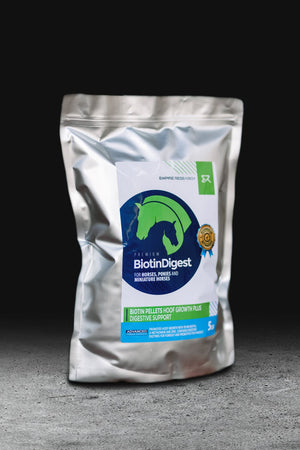
A superior hoof formula combined with full-spectrum digestive enzymes and pre- & probiotics — hoof-growth support plus the absorption to make it count, in one daily scoop.
Frequently asked questions
How long does biotin take to work on horse hooves?
What's the best supplement for cracked or crumbling hooves?
Can diet cause thrush?
Do I still need my farrier if I'm feeding a hoof supplement?
The bottom line
Strong feet are grown, not fixed overnight. Feed the hoof what it needs — biotin, zinc, copper and quality amino acids — support the gut that absorbs them, keep the environment clean and dry, and let your farrier do their part. Give it a full hoof-growth cycle and you'll see the difference where it counts: at the ground.
Grow a stronger hoof from the inside out
Biotin30 Digest — hoof-growth nutrients plus digestive support, so your horse absorbs every bit.